
Welcome to the 2025 Year Ahead!
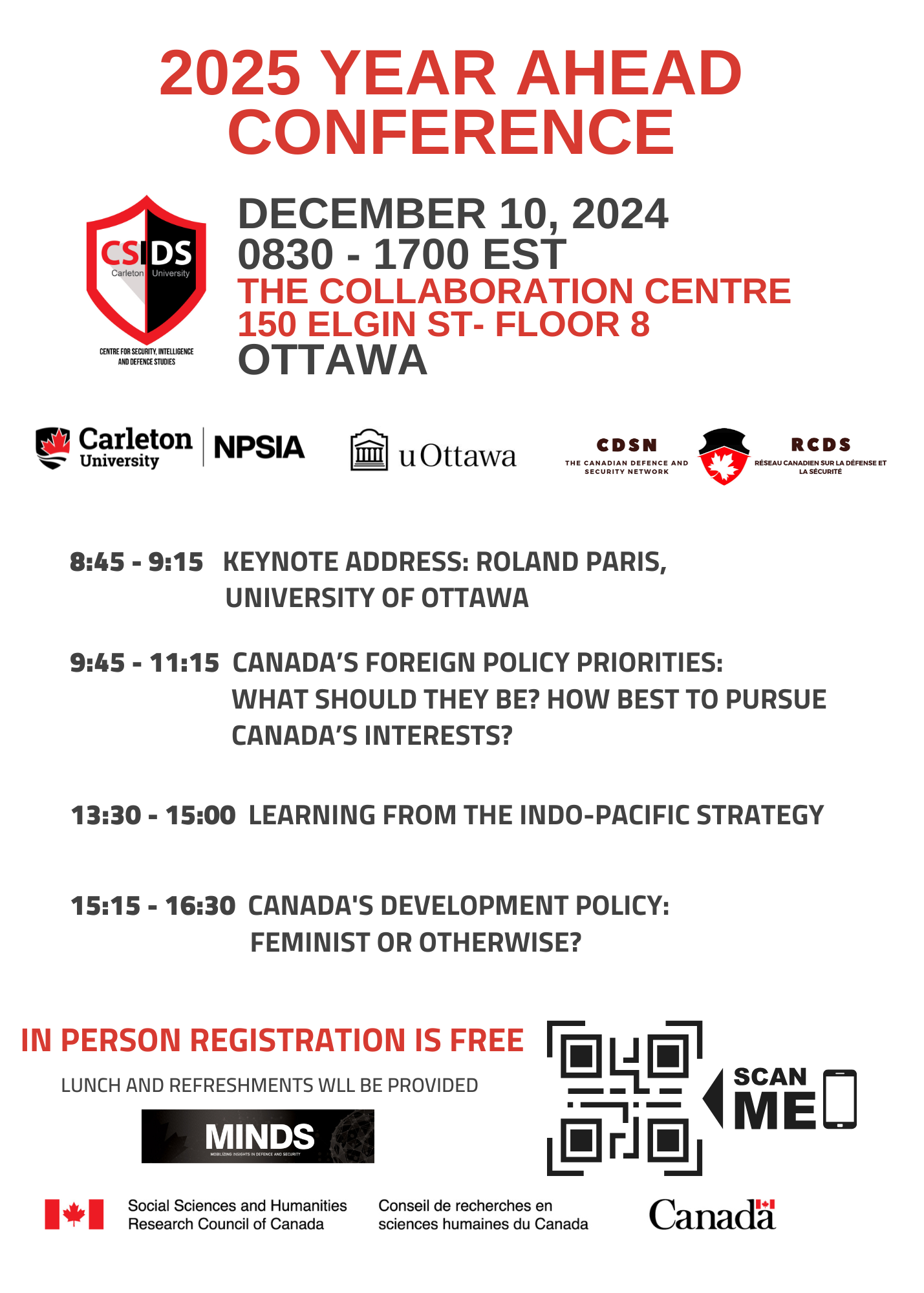
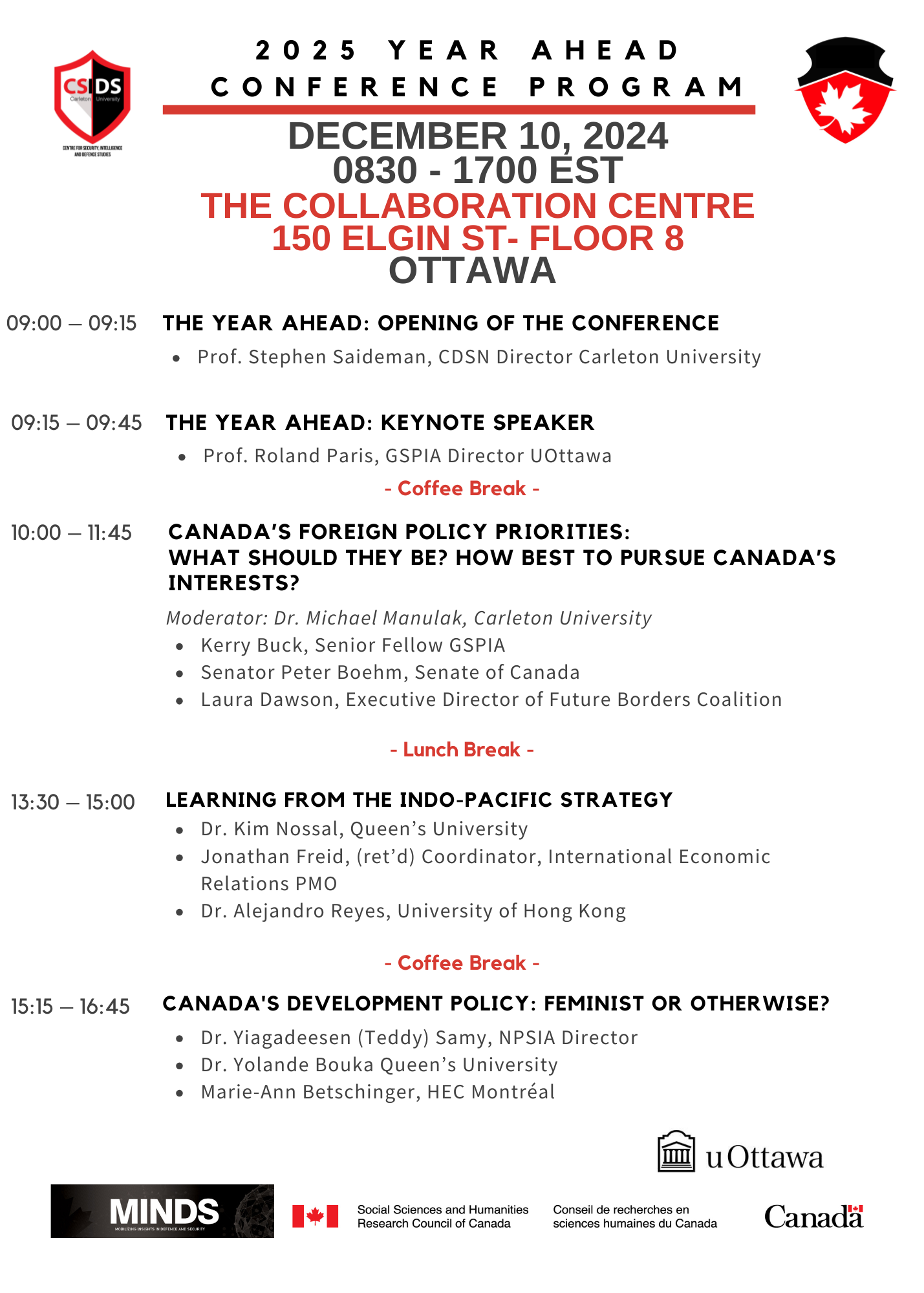
Opening Address of the 2025 Year Ahead
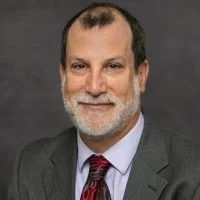
Prof. Stephen M. Saideman, CDSN Director
Stephen M. Saideman is the Paterson Chair in International Affairs at Carleton University. His research interests focus on the causes and consequences of intervention into intra-state conflicts. He has written books on the international relations of secession, why there were both more and less wars in Eastern Europe after the end of the Cold War, on NATO in Afghanistan, and on Canada’s Afghanistan experience. His current research focus is on the role of legislatures in democratic civil-military relations. He teaches courses on Contemporary International Security, Civil-Military Relations and US Foreign and Defence Policy. stevesaideman.com
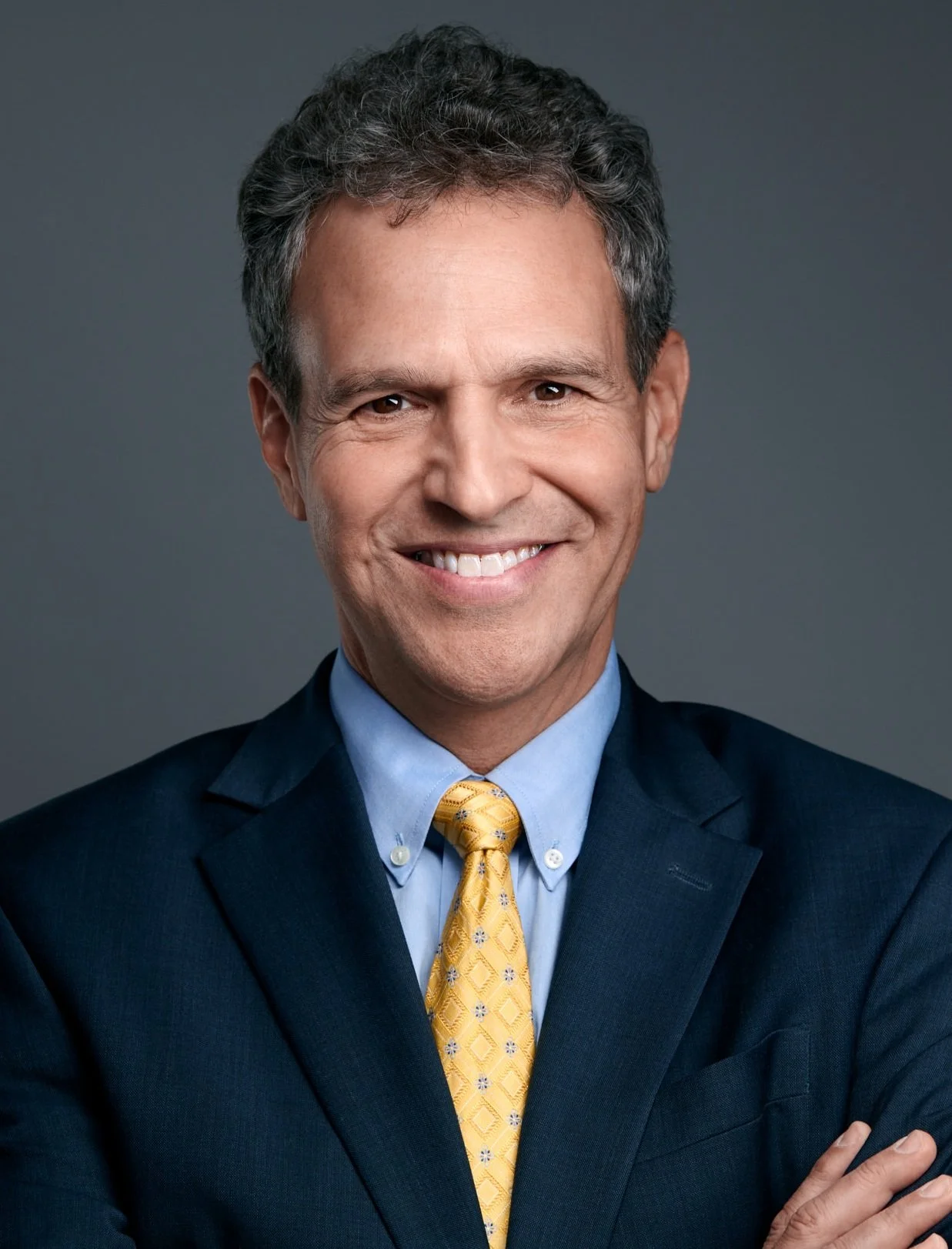
Prof. Roland Paris, GSPIA Director
Roland Paris is Professor of International Affairs and Director of the Graduate School of Public and International Affairs at the University of Ottawa. He has taken several academic leaves to serve as a policy advisor in the Canadian government, including in its foreign ministry, Privy Council Office, Federal-Provincial Relations Office, and Prime Minister’s Office. He has written widely on international security, peacebuilding and foreign policy topics and earned several research prizes as well as awards for his teaching and public service. He is also Associate Fellow of Chatham House.
2025 Year Ahead: Keynote Speaker
Canada’s Foreign Policy Priorities
10:00 -11:45
-
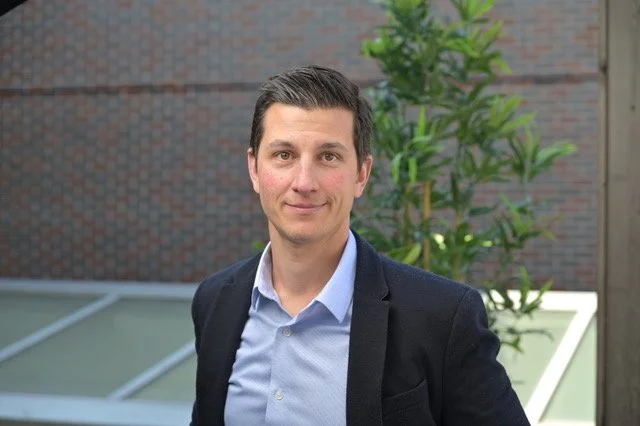
Moderator: Dr. Michael Manulak
Michael W. Manulak is Associate Professor at the Norman Paterson School of International Affairs, Carleton University. He is author of Change in Global Environmental Politics: Temporal Focal Points and the Reform of International Institutions (Cambridge University Press 2022). His academic work has appeared in Review of International Organizations, Foreign Affairs, and Global Environmental Politics. He is co-author of the Advisory Panel report Canada and the United Nations: Rethinking and Rebuilding Canada’s Global Role. From 2015-2019, he served in the Government of Canada, mainly within the Department of National Defence, representing the government internationally on proliferation security issues. His doctorate is from the University of Oxford (St. Antony’s College).
-
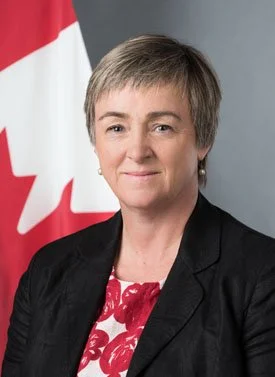
Kerry Buck
Kerry Buck joined Canada’s then Department of External Affairs and International Trade in 1991. She most recently was Assistant Secretary to the Treasury Board responsible for economic sector.
Prior to that she served as Canada’s Ambassador and Permanent Representative to the North Atlantic Council (NATO). Previous senior diplomatic positions include Political Director and Assistant Deputy Minister for International Security and Political Affairs, Assistant Deputy Minister for Africa, for Latin America and the Caribbean, head of the Afghanistan Task Force, Director General for the Middle East and Maghreb and Director for Human Rights. She was also posted to the Canadian Permanent Mission to the United Nations in New York. Outside of the Department of Foreign Affairs, Trade and Development Canada, Ms. Buck served in the Privy Council Office, the Canadian Human Rights Commission, the International Development Research Centre and the Constitutional Law Bureau of the Office of the Attorney General of Ontario.
-
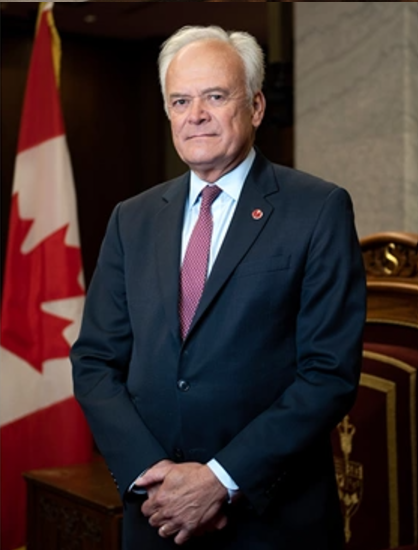
Senator Peter M. Boehm
Born in Kitchener, Ontario, Senator Peter M. Boehm holds a Ph.D in History from the University of Edinburgh, a Master of Arts in International Affairs from the Norman Paterson School of International Affairs at Carleton University, and a Bachelor of Arts in English and History from Wilfrid Laurier University.
He was Deputy Minister for the G7 Summit and Personal Representative of the Prime Minister (Sherpa) from July 2017, until his retirement from the public service in September 2018. Peter Boehm had previously been Deputy Minister of International Development, Associate, and, subsequently, Senior Associate Deputy Minister of Foreign Affairs. From 2013 to 2017, he concurrently served as Sherpa for the G8 and subsequent G7 Summits, as well as the Nuclear Security Summit.
A former career foreign service officer, he served as Ambassador to Germany from 2008 to 2012 and previously as Assistant Deputy Minister for the Americas, North America and Consular Affairs. Abroad, he was Minister (political and public affairs) at the Embassy of Canada to the United States in Washington and Ambassador and Permanent Representative to the Organization of American States. He has held a variety of diplomatic positions including assignments in Cuba and Costa Rica. He was National Summit Coordinator for the Santiago and Québec Summits of the Americas, Special Envoy for the Organization of American States Democratization Mission in Peru and Personal Representative (Sherpa) of the Prime Minister for the Summit of the Americas in Mar del Plata in 2005. From 2005 to 2008, he was the senior official responsible for the annual North American Leaders’ Summit.
He is a recipient of the Public Service of Canada Outstanding Achievement Award and the Canadian Foreign Service Officer Award for his contribution to advancing peace in Central America. He was appointed to the Senate of Canada, representing the province of Ontario in October 2018. He is currently the Chair of the Senate Standing Committee on Foreign Affairs and International Trade.
-
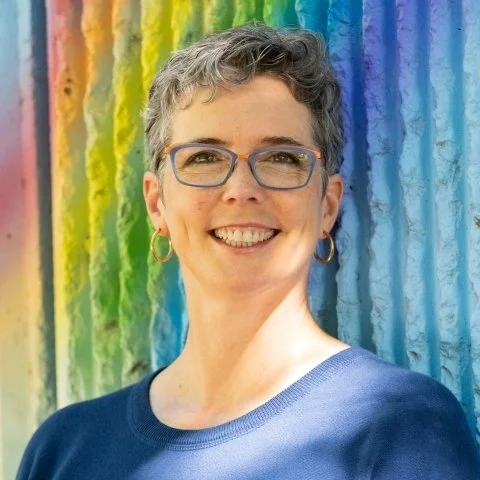
Dr. Laura Dawson
As Executive Director of Future Borders Coalition, Laura Dawson works with a binational coalition of government and industry leaders in order to build better borders for travel and trade. Prior to her appointment to FBC, Dr. Dawson led the North America office of the Amazon Web Services (AWS) Institute, facilitating public sector digital transformation. Other posts include director of the Canada Institute at the Wilson Center in Washington, D.C., founder of Dawson Strategic, and senior economic advisor at the U.S. Embassy in Canada. Dawson serves on the teaching faculty at the Master of Public Policy program at McGill University in Montreal and is a board member of the Canadian Global Affairs Institute. In addition, Dawson was jury co-chair for the Government of Canada’s 2022 New Frontiers in Research Fund and was named 2021 Person of Distinction by the Public Affairs Association of Canada. Dr. Dawson holds a Ph.D in Political Science from Carleton University. She lives in Atlanta, Georgia.
Learning From the Indo Pacific Strategy
13:30 - 15:00
-

Moderator: Dr. Stephen M. Saideman
Stephen Saideman holds the Paterson Chair in International Affairs at Carleton University’s Norman Paterson School of International Affairs and is the Director of the Canadian Defence and Security Network. He has written four books: The Ties That Divide: Ethnic Politics, Foreign Policy and International Conflict; For Kin or Country: Xenophobia, Nationalism and War (with R. William Ayres); NATO in Afghanistan: Fighting Together, Fighting Alone (with David Auerswald); and Adapting in the Dust: Lessons Learned from Canada’s War in Afghanistan, as well as articles and chapters on nationalism, ethnic conflict, civil war, alliance dynamics, and civil-military relations. Prof. Saideman has received fellowships from the Council on Foreign Relations and the Social Sciences Research Council. The former placed on the Bosnia desk of the Strategic Planning and Policy Directorate of US Joint Staff for a year, and the latter facilitated research in Japan. He taught previously at the University of Vermont, Texas Tech University, and at McGill University. He writes online including at his own site (saideman.blogspot.com). He has won awards for teaching, for mentoring other faculty, for public engagement, and for his blogging on international studies. He is currently working on the role of legislatures in civil-military relations in many democracies around the world. He tweets at @smsaideman, and co-hosts the Battle Rhythm podcast.
-
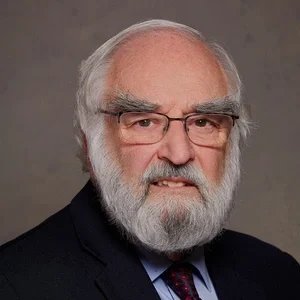
Dr. Kim Nossal
Kim Richard Nossal went to school in Melbourne, Beijing, Toronto, and Hong Kong and attended the University of Toronto, receiving his Ph.D in 1977. In 1976 he joined the Department of Political Science at McMaster University in Hamilton, Ontario, where he taught international relations and Canadian foreign policy, serving as chair of the Department from 1989–90 and 1992-1996. In 2001, he came to Queen’s University, heading the Department of Political Studies until 2009. He served as director of the Centre for International and Defence Policy from 2011 to 2013. From 2013 to 2015, he was the executive director of the Queen’s School of Policy Studies. He has served as editor of International Journal, the quarterly journal of the Canadian International Council, Canada's institute of international affairs (1992-1997), and was president of the Canadian Political Science Association (2005-2006). He served as chair of the academic selection committee of the Security and Defence Forum of the Department of National Defence from 2006 to 2012. In 2017 he was awarded an honorary doctorate by the Royal Military College of Canada. Professor Emeritus Nossal retired from Queen's Department of Political Studies in 2020.
-
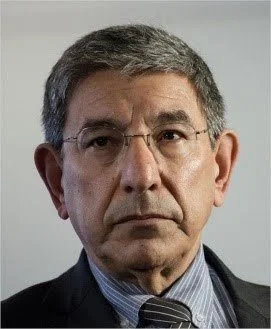
Amb. Jonathan Fried
Mr. Fried’s distinguished diplomatic career for Canada spanned law, economics and trade. Prior to his retirement in August 2020, he was Coordinator for International Economic Relations at Global Affairs Canada, with a mandate encompassing responses to the COVID pandemic, and Canada-Asia and other international trade and economic matters. From 2017 to early 2020, he was the Personal Representative of Prime Minister Justin Trudeau for the G20. Previously, he served as Canada’s Ambassador and Permanent Representative to the WTO 2012-2017, where he played a key role as Chair of the WTO’s General Council in 2014 and Chair of the Dispute Settlement Body in 2013. He was the co-Chair with China of the G20’s Trade and Investment Working Group in 2015, and the “Friend of the Chair” for Germany in 2016. He was Canada’s representative to APEC’s Vision Group that set out in 2019 long-term objectives for the forum. Formerly Canada’s Ambassador to Japan; Executive Director for Canada, Ireland and the Caribbean at the IMF; Senior Foreign Policy Advisor to the Prime Minister; Senior Assistant Deputy Minister for the Department of Finance and Canada's G7 and G20 Finance Deputy. Mr. Fried has also served as Associate Deputy Minister; Assistant Deputy Minister for Trade, Economic and Environmental Policy; Chief Negotiator on China’s WTO accession; chief counsel for NAFTA; and Counsellor for Congressional Affairs at the Canadian Embassy in Washington, DC. Mr. Fried is a Senior Advisor with the Albright Stonebridge Group in Washington, DC, Senior Associate to the Center for Strategic and International Studies also in Washington, DC, and is on the Advisory Group to Independent Economics Consulting in London, UK. He is a Distinguished Fellow of the Asia-Pacific Foundation and of the Canadian Global Affairs Institute and is a member of the World Economic Forum’s Trade Action Group. He is a member of the Board of the Friends of Multilateralism Group (FMG) in Geneva and serves on the Advisory Boards of the Columbia Center on Sustainable Investment and the Central and East European Law Institute. He was bestowed by the Emperor of Japan with the Order of the Rising Sun in November 2022 and was the inaugural recipient of the Public Sector Lawyer Award by the Canadian Council on International Law in 2015 to honor his service and contribution to public international law. Mr. Fried received his BA and LLB from the University of Toronto and LLM from Columbia University. He is a member of the Law Society of Alberta.
-
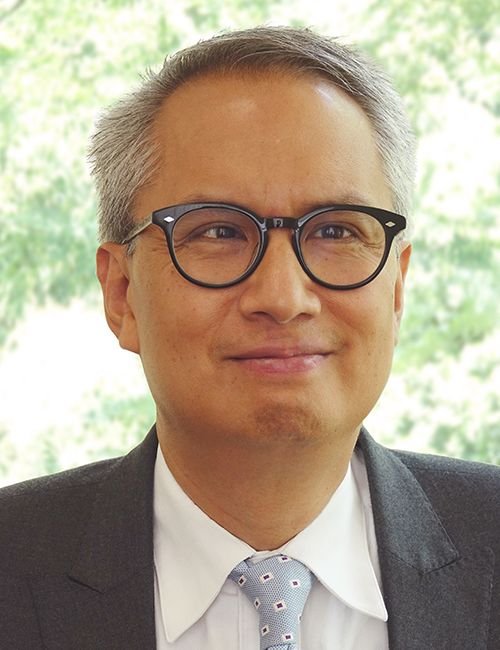
Dr. Alejandro Reyes
Alejandro Reyes is Director of Knowledge Dissemination and an adjunct professor at Asia Global Institute, where he manages the Asia Global Online journal. Prior to joining the institute, he was for two years Senior Policy Advisor to the Assistant Deputy Minister for Asia Pacific and Convenor of the Asia Pacific Policy Hub at Global Affairs Canada, the Canadian Foreign Ministry. He had previously served in the department in 2002 as a senior policy advisor to the Canadian Foreign Minister. From 2007 to 2017, he was a visiting associate professor in the Department of Politics and Public Administration at the University of Hong Kong. A Hong Kong-based independent consultant from 2001 to 2017, he worked with several foundations and international organizations including the G20 Business Summit, the Clinton Global Initiative, the World Economic Forum and the U.S.-Asia Institute, as well as some corporate clients. He has edited or written several books including a short history of Manila in the closing days of the Japanese Occupation, an Asian investment guide, and a survey of the financial services sector in Asia. He began his professional career as a journalist with Asiaweek Magazine, part of Time Inc., where he worked from 1988 to 2001 in Hong Kong and Singapore. Born in the Philippines and a citizen of Canada, he was educated at Harvard University and the University of Oxford and in 2000 was awarded an honorary doctorate by Queens University in Charlotte, North Carolina.
Canada’s Development Policy: Feminist or Otherwise?
15:15 - 16:45
-
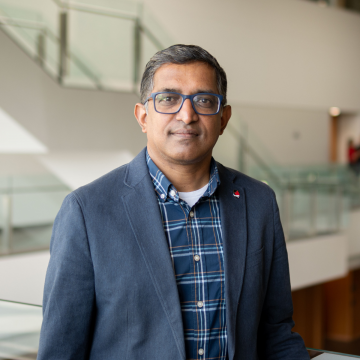
Moderator: Dr. Yiagadeesen (Teddy) Samy
Yiagadeesen (Teddy) Samy is a Professor of international affairs at the Norman Paterson School of International Affairs (NPSIA) at Carleton University. He is currently in his second term as the Director of NPSIA, after serving a first term from 2017 to 2022. Prior to that, he served as Associate Director (MA program) from 2010 to 2016, and as Acting Associate Director (MA program) from 2008 to 2009. Since joining NPSIA in 2003, he has taught graduate courses in development economics, international trade, macroeconomics for developing countries, development assistance and quantitative methods. Professor Samy’s research interests intersect the broad areas of international and development economics, and his current research focuses on domestic resource mobilization, fragile states, foreign aid, deindustrialization and income inequality, and trade and women’s economic empowerment. He recently coedited a Handbook on Fragile States (Edward Elgar Publishing, 2023) and his latest co-authored book is Trade and Women’s Economic Empowerment: Evidence from Small and Medium-Sized Enterprises (Palgrave Macmillan, 2023).
-
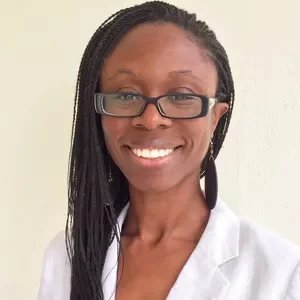
Dr. Yolande Bouka
Yolande Bouka (Ph.D. American University) is an Assistant Professor in the Department of Political Studies at Queen’s University. Her research and teaching focus on gender, African politics and security, political violence, and field research ethics in conflict-affected societies. She holds a Ph.D. in International Relations from American University. Her current research is a multi-sited historical and political analysis of female combatants in Southern Africa. Her previous research which is now a book manuscript “In the Shadow of Prison: Power, Identity, and Transitional Justice in Post-Genocide Rwanda” focused on the social and political impacts of the powerladen nature of the Rwandan transitional justice program. Her research has received support from the Fulbright Scholar Program and the American Association of University Women. Prior to joining Queen’s University, she was a Visiting Assistant Professor at the Elliott School of International Affairs at George Washington University, and a Post-Doctoral Fellow at the University of Denver. In addition to her academic work, she has extensive experience with development and security research agencies. She has worked with and offered support to USAID, the UK Department for International Development, the United Nations, the African Union, the Center for Strategic and International Studies, and the United States Institute of Peace. Between 2014 and 2016 she was a researcher at the Institute for Security Studies (ISS) in the Conflict Prevention and Risk Analysis Division in Nairobi, Kenya, where she led research on peace and security in Africa’s Great Lakes Region. She currently serves on the Research Advisory Council of the RESOLVE Network, a global consortium of researchers, research organizations, policymakers, and practitioners committed to empirically driven, locally-defined research on the drivers of violent extremism and sources of community resilience.
-
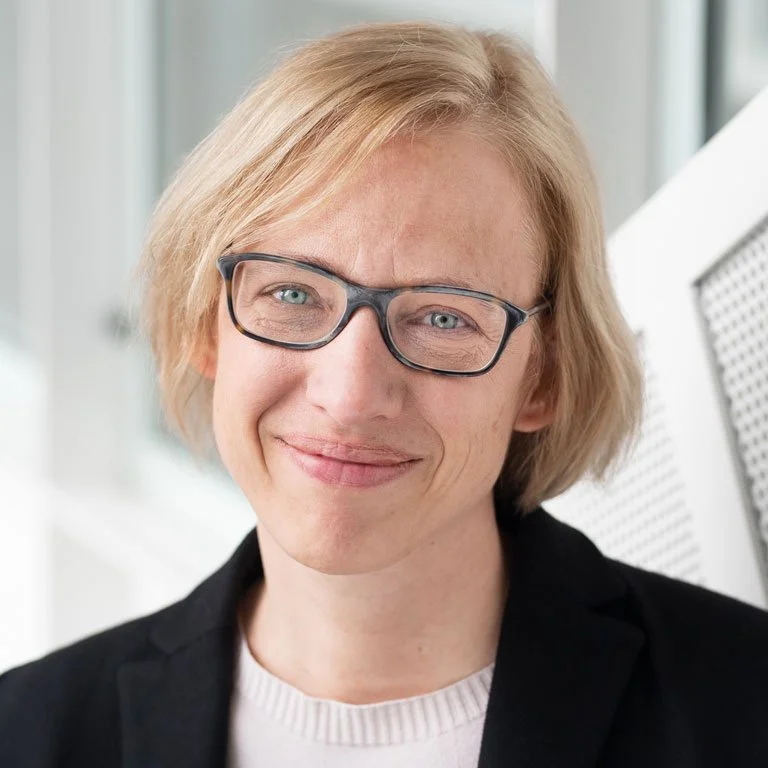
Dr. Marie‑Ann Betschinger
Marie‑Ann Betschinger is Associate Professor of Strategy at HEC Montreal in Canada. Her research focuses on corporate and international strategy. She is particularly interested in different forms of firm internationalization, mergers & acquisitions, corporate governance, and the political and social context within which firms act.
-
Amb. Patricia Peña
Associate Assistant Deputy Minister– International Assistance Partnerships and Programming Global Affairs Canada Patricia Peña leads a multi-faceted team at Global Affairs Canada responsible for the delivery of Canada’s international assistance, and increasing impact, innovation and engagement with a wide range of partners, including in the areas of development finance, and social and economic development. She has a rich and longstanding history working with Canadian, multilateral, civil society, private sector, philanthropic and diplomatic partners globally. Since joining the Government of Canada in 2007, she held a number of senior positions at Global Affairs Canada and the Canadian International Development Agency (CIDA). She served as Canada’s Ambassador to Chile (2017-2020), Director General Foreign Policy and Director General Economic Development. From 2007 to 2011, Patricia held various policy and operational positions at CIDA, including as Director Democratic Governance and Human Rights, and Director of Economic Development and Natural Resources. Prior to joining the Canadian public service, Ms. Peña lived for almost ten years in London, England and worked in various public sector agencies, including the UK Electoral Commission where she oversaw political financing regulation in the United Kingdom. Patricia Peña has an undergraduate degree in Political Science from the University of Toronto and a Master's degree at the London School of Economics and Political Science.